Is a High Floor Worth Paying More For in a Singapore Condo?
A higher floor can be worth paying for, but height itself is not the investment thesis. The real decision is whether the extra dollars buy a durable advantage—such as a better and reasonably protected view, less direct exposure or greater privacy—that future buyers can still recognise and afford.
Do not pay for height by itself. Pay only when height creates a durable advantage that a future buyer can still recognise, value and afford.
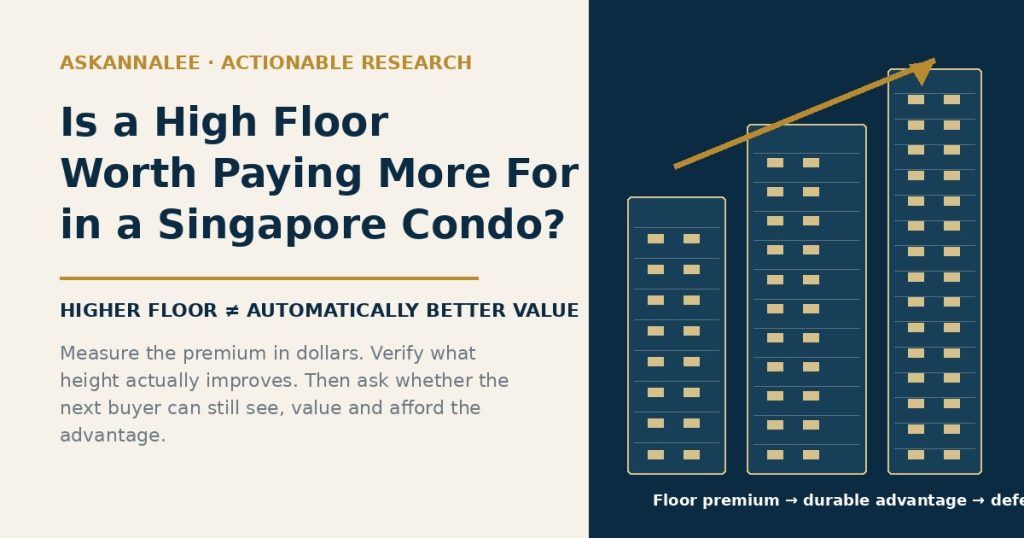
A higher floor can command a premium. The investment question is whether the premium buys something durable enough to survive into resale.
Quick Answer
Yes—but not automatically. Singapore evidence supports the existence of floor-level price premiums, yet a higher purchase price does not guarantee a better investment return. The right question is therefore not “Are high floors more expensive?” but “Is this specific high-floor premium recoverable?”
Why Higher Floors Can Command a Premium
There is credible evidence that floor level affects condominium pricing in Singapore. A published study using 3,367 District 23 resale transactions from May 2012 to April 2015 found a statistically significant positive relationship between floor level and resale price. More recent market datasets also show higher median prices or PSF across higher floor bands, although those broad datasets do not fully control for unit type, view, project mix or penthouse effects.
That distinction matters. A price premium proves that buyers may pay more for height. It does not prove that every high-floor buyer earns a superior return.
A materially better and reasonably protected view; less direct road or facility exposure; better privacy; or a scarce position that competing units cannot easily reproduce.
The view is similar, noise/privacy barely changes, many competing units offer the same experience, or the price ladder rises faster than the benefits.
Start With a Like-for-Like Comparison
The cleanest test is inside the same development. Compare the same unit type and, where possible, the same stack or facing across nearby floor bands and similar transaction periods.
Do not compare a 20th-floor pool-facing unit with a 5th-floor road-facing unit and call the entire difference a floor premium. That price gap contains several variables at once: floor, view, noise, privacy and possibly launch timing.
AskAnnaLee rule: the more variables you change, the less confidently you can attribute the price difference to height.
Measure the Premium in Dollars Before You Judge It
Then calculate the dollar premium. That number is usually more useful than the percentage because it tells you exactly how much additional capital must be recovered later.
| Item | Lower-floor comparable | Higher-floor candidate |
|---|---|---|
| Purchase price | S$1,800,000 | S$1,890,000 |
| Dollar premium | — | S$90,000 |
| Premium % | — | 5.0% |
Decision question: does the higher unit give you at least S$90,000 of defensible advantage relative to the substitute?
Do Not Use a Market-Wide Floor Premium as Your Buying Rule
Broad Singapore datasets are useful for establishing that floor premiums exist, but they are a poor substitute for project-level analysis. Floor bands can contain different projects, unit sizes, views, market segments and penthouses. A market-wide median can therefore tell you direction, but not the fair premium for a particular unit.
For an actual purchase, prioritise same-project transaction evidence. URA’s private residential transaction service provides up to 60 months of transaction records, while REALIS offers more detailed statistics. Use those records to build your own floor ladder for the development you are studying.
The View Premium and the Floor Premium Are Not the Same Thing
A higher floor may be worth more because it unlocks a better view—but then you are partly paying for the view, not merely the floor number.
Separate the two questions:
- Floor benefit: does height improve privacy, noise exposure, breeze or openness?
- View benefit: does the unit gain a materially better outlook that is scarce and difficult to replicate?
This distinction becomes critical when two high-floor stacks have very different outlooks. If one faces a permanent open space and another faces a future development plot, the same floor number can carry very different resale value.
Check Whether the View Can Disappear
A premium based on an unblocked view is only as durable as the land in front of it. Check the URA Master Plan and URA SPACE for surrounding land use and planning context. The Master Plan guides Singapore’s development over the next 10 to 15 years, so it is an important starting point for identifying land that may change.
Do not interpret the plan as a guarantee that a specific view will remain permanently protected. Treat it as planning evidence to be combined with site inspection, plot orientation and project-specific information.
Higher Floor Does Not Automatically Mean Better Return
This is where price discipline matters. A high-floor unit can sell for more and still deliver a weaker percentage return if you paid too much for the premium at entry.
Recent third-party matched-resale analysis illustrates the point: its high-floor band did not produce the strongest median annualised resale return, even though floor premiums are observable in pricing. The dataset is directional rather than a controlled experiment, but it reinforces an important principle: paying a premium and earning a premium are different questions.
Work Backwards From the Future Buyer
Your future buyer does not inherit your original reasoning. They will compare your unit against whatever alternatives exist at that time.
Ask three questions:
- Will the buyer immediately notice the high-floor advantage?
- Will competing units offer something similar for less?
- Can the likely buyer still finance the resulting total quantum?
A S$90,000 premium is easier to defend when the advantage is obvious and scarce. It is harder when buyers can move five floors lower and give up almost nothing.
Worked Example: When a 5% Premium Can Still Be Too Much
Assume two otherwise similar units in the same development:
| Factor | Lower floor | Higher floor |
|---|---|---|
| Price | S$1.80m | S$1.89m |
| Premium | — | S$90,000 / 5.0% |
| View | Partially open | More open |
| Road noise | Noticeable | Reduced, but still present |
| Future obstruction | Same planning risk | Same planning risk |
| Likely buyer pool | Broader quantum | Slightly narrower quantum |
The higher floor is objectively better, but the investment case remains incomplete. If comparable resales historically show only a modest spread and the view is not protected, paying the full S$90,000 may leave little margin of safety.
The higher floor materially changes the view or liveability; the advantage is scarce; obstruction risk is low; same-project evidence supports a resale spread; and the final quantum remains accessible.
The floor number is higher but the lived experience changes little; the view is temporary/common; the premium is much larger than resale evidence; or the resulting quantum pushes buyers toward better alternatives.
Research Worksheet: Build Your Own Floor-Premium Ladder
Before deciding, record at least three comparable units and complete this worksheet.
| Research item | Your evidence |
|---|---|
| Candidate unit / floor / stack | ________________ |
| Best lower-floor comparable | ________________ |
| Dollar premium | ________________ |
| Premium % | ________________ |
| What improves because of height? | ________________ |
| View permanence / obstruction risk | ________________ |
| Same-project resale evidence | ________________ |
| Future buyer / likely budget | ________________ |
| Maximum defensible premium | ________________ |
8 Checks Before You Pay the High-Floor Premium
Do not treat this as a mechanical score. Use the eight checks to expose where the premium is genuinely supported—and where the thesis depends on assumption.
Like-for-Like Test
Are you comparing the same development, similar unit size, similar stack/facing and a similar transaction period? If not, the observed price gap may not be a floor premium at all.
Dollar-Premium Test
Convert the difference into actual dollars, not only PSF or percentage. Ask what specific benefits must justify that amount.
View & Obstruction Test
Does the higher floor create a materially better outlook, and is that outlook reasonably durable after considering surrounding plots and future development?
Noise & Privacy Test
Does height meaningfully improve road, facility or neighbour exposure? Verify the actual site conditions instead of assuming every higher floor is quieter or more private.
Scarcity Test
How many units in the same project or nearby alternatives can offer substantially the same benefit? A premium is easier to defend when the advantage is genuinely scarce.
Quantum Test
After paying the premium, does the total purchase price remain within the natural budget of the likely future buyer pool?
Resale-Evidence Test
Do same-project transactions show that buyers repeatedly pay more for the relevant floor/view band, rather than only at launch?
Thesis-Breaker Test
What evidence would make you reject the high-floor premium—for example weak resale spreads, obstruction risk, or a cheaper substitute with almost the same lived experience?
How to Interpret the High-Floor Test
The more the premium depends on durable, observable and scarce advantages, the stronger the case. The more it depends on height alone, the more price-sensitive you should be.
Premium looks defensible
The higher floor creates obvious, durable and scarce benefits; the dollar premium is proportionate; same-project evidence supports it; and the resulting quantum remains realistic for the future buyer.
Premium needs negotiation
The higher floor is better, but the asking premium is larger than the evidence can comfortably support. The unit may still work at a lower entry price.
Premium is difficult to defend
Most of the premium comes from height itself, the view is temporary or common, comparable resales show little support, or the higher quantum narrows the future buyer pool too much.
Test the Premium Before You Commit
Compare the high-floor candidate against the best realistic substitute, then work backwards from the resale price and future buyer rather than from the developer’s asking ladder.
COMPARE VALUERead PSF vs Quantum →
CHECK RESALERead the Resale Guide →
Apply the framework to a real project
When reading a New Launch Analysis, compare the actual floor ladder, stack, view, quantum and future buyer—not just the headline PSF.
Work backwards from exit
A premium is safer when the future selling price can be defended without optimistic appreciation assumptions.
Sources & Verification
Primary and supporting sources used for this guide:
- URA — Private Residential Property Transactions
- URA — Private Residential Properties / Property Data
- URA — Master Plan 2025
- Khiew & Lee (2019) — Floor-level premiums in private housing: the case of condominiums in Singapore
- Kelly Mark Property — Singapore Floor-Level Premium Analysis (supporting market dataset)
- ShiokNest — High-Floor Resale Return Analysis (supporting directional dataset)
URA transaction data should be used for project-specific comparisons. The academic and third-party studies establish that floor premiums can exist and illustrate market patterns; they do not determine the fair premium for a specific unit. Worked examples in this article are illustrative, not forecasts.
Educational disclaimer: This guide is for general education and property research only. It is not financial, tax, legal or investment advice. Verify current transaction data, planning information and project-specific facts before making a property decision.