Which Condo Unit Should You Buy Within the Same Development?
Unit selection is where floor, stack, view, layout and price finally meet. This framework helps buyers rank the complete package rather than overpaying for one attractive feature.
Do not choose a condo unit by maximising one feature. Choose the combination of floor, stack, view, layout and price that the future buyer can still understand and afford.
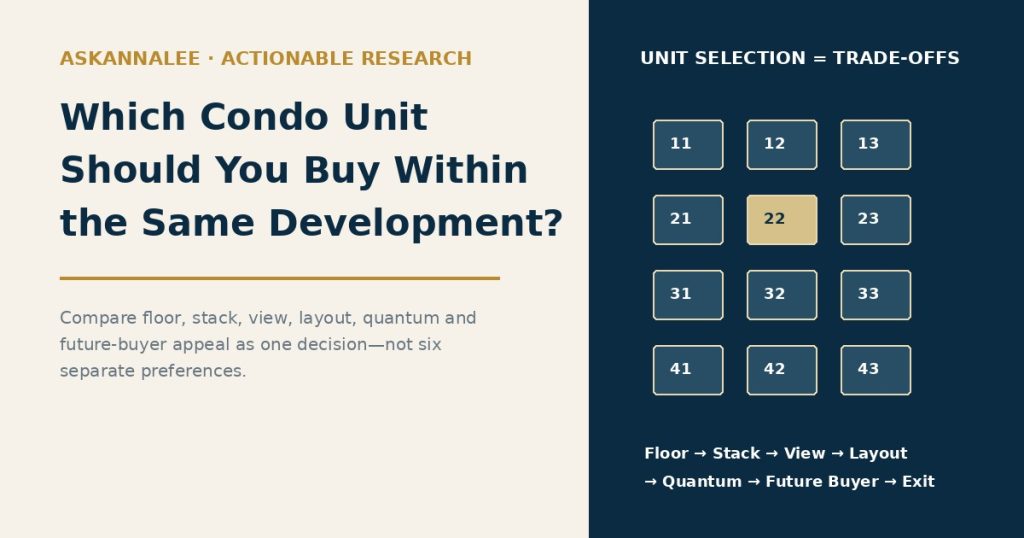
The best unit is rarely the one that wins every category. It is the one whose combined advantages justify the combined premium.
Quick Answer
Choose the unit by comparing floor, stack, view, layout, total quantum and future-buyer appeal together. Start with the best realistic substitute, then ask what additional benefits the preferred unit gives you and how many dollars you are paying for them. A premium unit is attractive only when its advantages are durable enough to survive into resale.
Why Unit Selection Should Be a Portfolio of Trade-Offs
Within one development, buyers often compare units one attribute at a time: higher floor, better facing, nicer view or more efficient layout. The problem is that each improvement can carry its own premium.
By the time those premiums are combined, the “best” unit may sit at a total quantum that future buyers find difficult to justify. Unit selection therefore needs a single decision framework that compares the complete package.
The floor, stack, view and layout create a clearly better lived experience, the differences are durable and the total premium remains reasonable.
The unit is objectively attractive, but the buyer pays separate premiums for height, view, stack and layout until the total quantum becomes difficult to recover.
Step 1 — Establish the Best Substitute
Do not begin with the unit you love most. First identify the cheapest realistic unit you would still be willing to own. It should have a comparable bedroom count and broadly similar household use.
This becomes the baseline. Every extra dollar paid for the preferred unit should buy a specific advantage relative to this substitute.
Step 2 — Separate Floor From Stack
Height and stack are related but not identical. A higher floor may improve openness or road noise, while the stack determines facing, privacy geometry, facility exposure and surrounding context.
Compare the same stack across floors where possible, then compare similar floors across stacks. This reduces the risk of attributing the entire price gap to the wrong feature.
Step 3 — Separate the View From the Marketing Label
Record what the unit actually sees from normal living positions and whether that outlook is scarce. Then investigate surrounding planning context before treating openness as permanent.
A view should add to the unit case only when it creates a recognisable benefit beyond the floor and stack advantages you are already paying for.
Step 4 — Make the Layout Earn Its Square Footage
Test normal furniture, bedroom usability, circulation, storage, kitchen utility and household flexibility. Two units with the same size can create very different lived experiences.
A better layout can justify paying more when the usefulness is obvious, but avoid paying a large premium for marginal improvements that future buyers can obtain elsewhere.
Step 5 — Add the Premiums Together
The combined premium is more important than debating each feature in isolation.
| Item | Best substitute | Preferred unit |
|---|---|---|
| Purchase price | S$1,900,000 | S$2,060,000 |
| Dollar premium | — | S$160,000 |
| Combined premium | — | 8.4% |
Decision question: do the combined floor, stack, view and layout advantages genuinely justify another S$160,000?
Step 6 — Check the Evidence Inside the Development
Use same-project transactions where available to understand how buyers have priced different unit types, floor bands and sizes. URA’s private residential transaction service provides recent transaction records, while REALIS provides more detailed property-market statistics.
Transaction records will not describe every qualitative difference. Pair them with the site plan, floor plans and actual unit characteristics rather than assuming every price spread represents a specific premium.
Worked Example: The Best Unit Can Still Be the Wrong Buy
Assume two units in the same development:
| Factor | Unit A — Substitute | Unit B — Preferred |
|---|---|---|
| Price | S$1.90m | S$2.06m |
| Floor | Mid | High |
| Stack | Acceptable | Quieter / more private |
| View | Partial openness | Wider outlook |
| Layout | Functional | Slightly better |
| Combined premium | — | S$160,000 / 8.4% |
Unit B wins every qualitative comparison. But that does not automatically make it the better investment. The buyer must decide whether those combined improvements are worth S$160,000 and whether the future buyer is likely to make the same judgement.
Several durable advantages reinforce one another, substitutes are materially weaker and the resulting total quantum remains realistic for the future buyer.
The premium unit wins on paper, but the cheaper unit gives up little that matters while preserving capital and widening the future buyer pool.
Research Worksheet: Rank the Units Before You Decide
Complete this for the preferred unit and its best substitute.
| Research item | Your evidence |
|---|---|
| Preferred unit / substitute | ________________ |
| Floor difference | ________________ |
| Stack / facing difference | ________________ |
| View / obstruction difference | ________________ |
| Layout / usability difference | ________________ |
| Preferred-unit price | ________________ |
| Substitute price | ________________ |
| Combined dollar premium | ________________ |
| Same-project evidence | ________________ |
| Future-buyer case | ________________ |
8 Checks Before You Choose the Unit
Use all eight checks together. The purpose is to stop one attractive feature from overwhelming the economics of the whole purchase.
Floor Test
Does the floor materially improve privacy, noise conditions, openness or buyer appeal, and is the extra floor premium proportionate to that advantage?
Stack Test
Does the stack have durable advantages in facing, heat exposure, noise, privacy or surrounding context compared with realistic substitutes?
View Test
Is the outlook obvious, scarce and reasonably durable, or are you paying for a view that is common, partial or vulnerable to future obstruction?
Layout Test
Does the floor plan convert its area into useful rooms, sensible furniture placement, storage, zoning and household flexibility?
Quantum Test
After combining all premiums, is the total purchase price still competitive with other units in the project and nearby alternatives?
Evidence Test
Do same-project transactions, available listings and project-specific evidence support the price differences you are being asked to pay?
Substitute Test
What is the best unit you can buy for less, and exactly what meaningful advantages do you lose by choosing that substitute?
Future-Buyer Test
Will the next buyer quickly understand why this unit is better and still have the budget to pay for those advantages at your required exit price?
How to Interpret the Unit-Selection Test
A strong unit combines durable advantages with a proportionate premium. A weak purchase can still be a beautiful unit if too much of the future value has already been paid upfront.
Preferred unit looks defensible
It wins on several durable attributes, the advantages are obvious to future buyers and the combined premium remains proportionate to the benefits and total quantum.
Right unit, wrong premium
The unit is genuinely preferable, but the price gap is larger than the evidence supports. Keep the unit ranking, but negotiate the premium.
Choose the better-value substitute
The preferred unit’s advantages are minor, fragile or already fully priced. A cheaper alternative preserves most of the lived experience and leaves more margin of safety.
Compare the Preferred Unit With the Best Substitute
Rank the units first. Then price the difference and work backwards from the future buyer.
UNIT SIZERead Small vs Large Condo Units →
COMPARE VALUERead PSF vs Quantum →
Test the future resale case
Check whether the unit’s advantages are likely to remain meaningful when completed alternatives compete for the same buyer.
Test whether the price is defensible
Separate a genuinely superior unit from a purchase where the premium has already become excessive.
Sources & Verification
Primary sources used for this guide:
- URA — Private Residential Property Transactions
- URA — Private Residential Properties / Property Data
- URA — Master Plan 2025
- URA — URA SPACE
URA transaction and planning sources establish the official market and planning context. Unit-specific conclusions require the development’s actual site plan, floor plans, price list and physical characteristics. Worked examples are illustrative.
Educational disclaimer: This guide is for general education and property research only. It is not financial, tax, legal or investment advice. Verify current transaction data, planning information and project-specific facts before making a property decision.