When Is a Premium Condo Unit Actually Worth Paying More For?
A better unit is worth more only when the future buyer can still recognise the advantage after you account for the extra capital paid today.
A better unit is worth more only when the future buyer can still recognise the advantage after you account for the extra capital paid today.
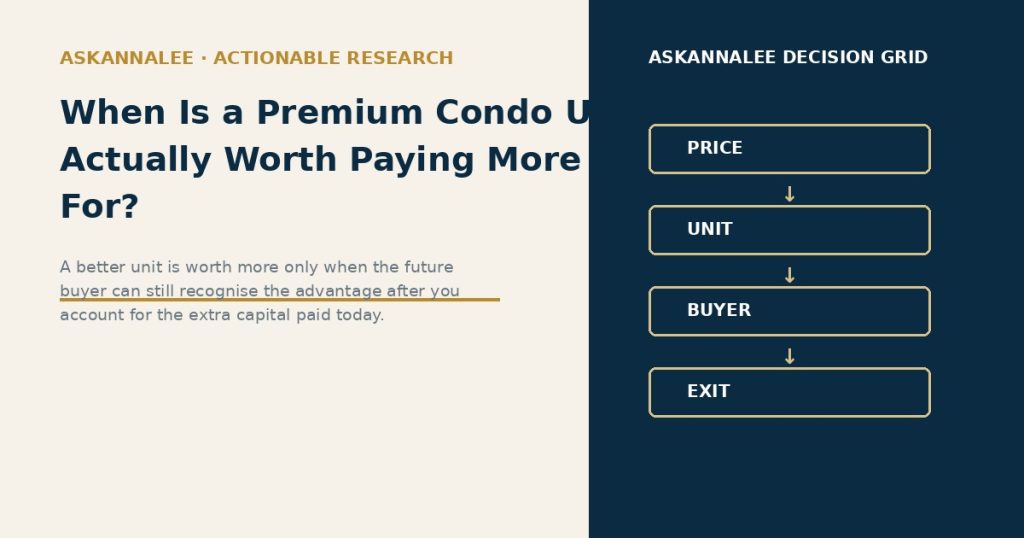
Use price, evidence, substitutes and the future buyer together. A strong unit can still be a weak purchase at the wrong premium.
Quick Answer
A better unit is worth more only when the future buyer can still recognise the advantage after you account for the extra capital paid today.
Start with the best realistic substitute, convert the difference into dollars and test whether the future buyer is likely to value the same advantages.
Why Premium justification and margin of safety Matters
Buyers often recognise a genuine qualitative difference but skip the harder question: how much is that difference worth? The price gap must be tested against evidence, competing units and the future buyer rather than accepted as a marketing fact.
This framework turns a preference into a decision that can be checked and repeated.
The preferred unit solves meaningful buyer problems, alternatives are materially weaker and the total quantum remains competitive.
The unit is better, but the difference is small, fragile or already fully reflected in the asking price.
Start With the Best Realistic Substitute
Choose the unit you would actually buy if the preferred unit disappeared today. Match bedroom count, broad size and household use as closely as possible. This creates a defensible baseline for the premium calculation.
Measure the Difference in Dollars
| Item | Substitute | Preferred unit |
|---|---|---|
| Price | S$1.92m | S$2.06m |
| Dollar premium | — | S$140,000 |
| Premium % | — | 7.3% |
Decision question: what specific, durable advantages are you receiving for S$140,000?
Do Not Confuse a Better Unit With a Better Return
A superior unit may command a higher resale price and still produce an ordinary return if the buyer paid the entire future advantage upfront. The investment question is therefore about the spread between what you pay now and what future buyers are likely to defend later.
Use Same-Project Evidence Before Market-Wide Rules
URA transaction records can help establish actual price ranges and recent deals. Pair those records with the project’s floor plans, site plan and unit characteristics. Avoid applying a generic premium percentage when the project itself provides better evidence.
Worked Example: Better Does Not Automatically Mean Better Value
| Factor | Substitute | Preferred unit |
|---|---|---|
| Price | S$1.92m | S$2.06m |
| Premium | — | S$140,000 / 7.3% |
| Advantages | Acceptable | Clearly better |
| Future buyer | Broader quantum | Must justify higher quantum |
| Margin of safety | Higher | Depends on evidence |
The preferred unit can still be the right choice, but only after the buyer establishes that its advantages are worth the full premium rather than merely desirable.
The premium buys durable, scarce advantages and the resulting quantum remains realistic.
The cheaper unit gives up little that matters and leaves materially more margin of safety.
Research Worksheet
| Research item | Your evidence |
|---|---|
| Preferred unit | ________________ |
| Best substitute | ________________ |
| Dollar premium | ________________ |
| Durable advantages | ________________ |
| Same-project evidence | ________________ |
| Competing alternatives | ________________ |
| Future buyer / exit quantum | ________________ |
| Walk-away condition | ________________ |
8 Checks Before You Pay the Premium
Use all eight checks together. No single attractive feature should override price, substitutes and the future buyer.
Like-for-Like Test
Is the comparison against a genuinely realistic substitute with similar size, bedroom count and household use?
Dollar-Premium Test
How many actual dollars are you paying above the best substitute, not merely how many percentage points?
Durability Test
Will the advantages remain meaningful after completion and through the likely holding period?
Quantum Test
Does the total purchase price remain accessible to the future buyer segment likely to want this unit?
Evidence Test
Do same-project transactions, listings, plans and physical characteristics support the claimed advantage?
Substitute Test
What can the buyer obtain for less within the development or nearby, and what meaningful benefits would be lost?
Future-Buyer Test
Can a future buyer recognise the advantage quickly and justify paying for it at your required exit price?
Thesis-Breaker Test
What fact, price or competing alternative would make this purchase no longer defensible?
How to Interpret the Decision
A defensible purchase combines real advantages with a proportionate premium and a realistic future buyer pool.
Case looks defensible
The advantages are durable, evidence-backed and large enough to justify the price gap while preserving a realistic future buyer pool.
Good unit, wrong price
The unit is attractive but the premium consumes too much margin of safety. Keep the preference but negotiate the price.
Choose the substitute or walk away
The cheaper alternative preserves most of the benefit, or the future buyer is unlikely to recover the extra capital paid today.
Compare the Unit With the Best Substitute
Price the difference first, then work backwards from the future buyer.
UNIT SIZERead Small vs Large Condo Units →
Test whether the unit is overpriced
Separate genuine quality from a premium that has become too large.
Work backwards from resale
Check whether future buyers are likely to defend the same advantages.
Sources & Verification
Primary sources used for this guide:
- URA — Private Residential Property Transactions
- URA — Private Residential Properties / Property Data
- URA — Master Plan 2025
URA sources provide transaction and planning context. Unit-specific conclusions require project plans, price lists and physical characteristics. Worked examples are illustrative.
Educational disclaimer: This guide is for general education and property research only. It is not financial, tax, legal or investment advice. Verify current transaction data and project-specific facts before making a property decision.