Freehold vs Leasehold Condo Singapore: Which Is Better?
Freehold gives longer tenure, but that does not automatically make it the better investment at every price. Compare the premium you pay today with remaining lease, location, property age, CPF usability, buyer demand and the price your future buyer may realistically support.
Do not pay for tenure in isolation. Ask how much premium you are paying for it — and whether the next buyer is likely to pay that premium back to you.
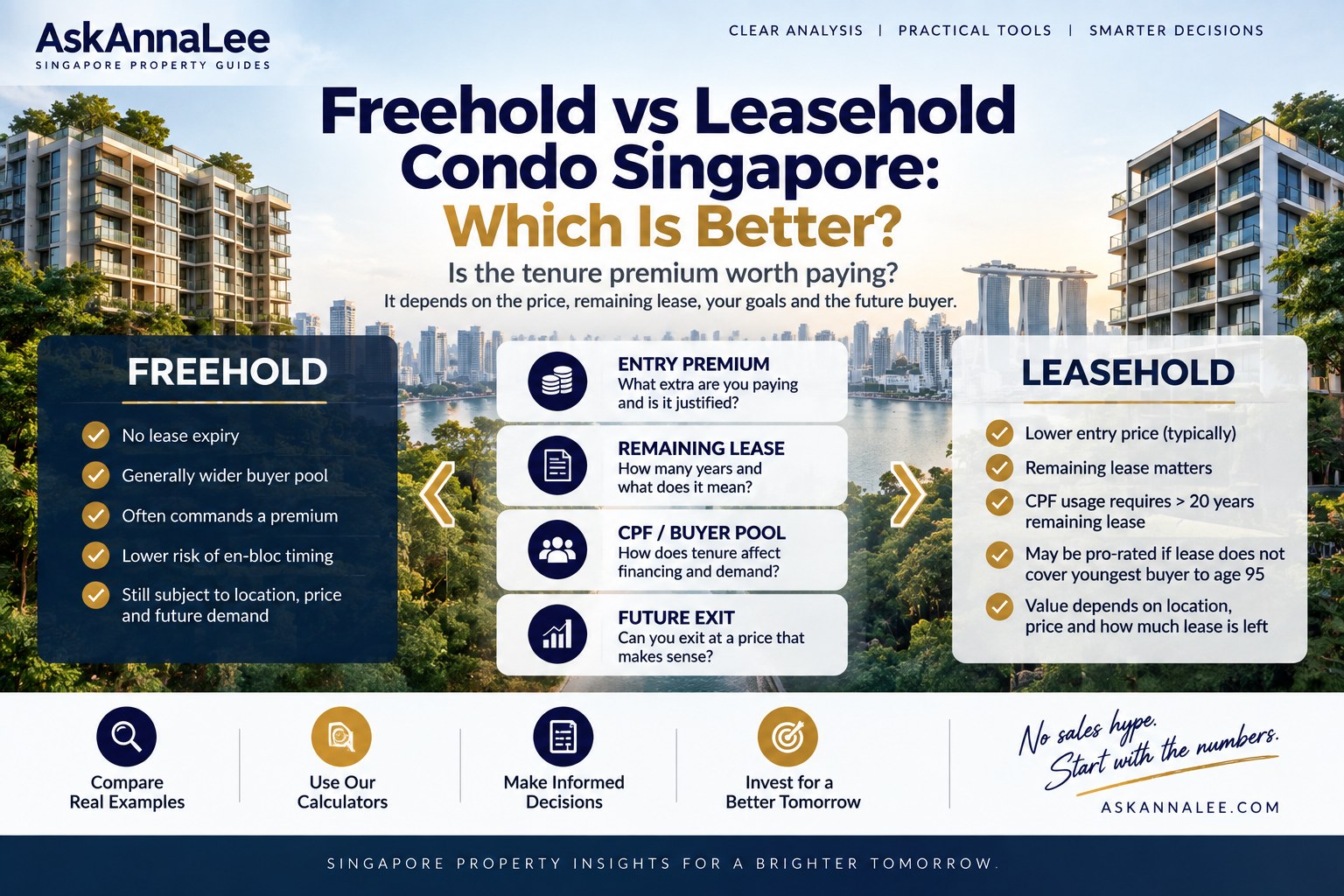
Tenure matters only in context. Compare the premium you pay for freehold with the leasehold alternative, your holding period, remaining lease at exit and the buyer pool you may eventually sell to.
Quick Answer
There is no universal winner between freehold and leasehold condos. Freehold removes the fixed 99-year lease expiry issue, while a leasehold property can still be compelling when its entry price, location, age, layout and future buyer pool are stronger.
The investment question is therefore not “freehold or leasehold?” It is “what premium am I paying for the tenure, and is that premium justified for my intended holding period and exit?”

Tenure should be tested as a price-and-exit question, not as a label. A longer tenure can be valuable, but the premium still needs to be supported by comparable transactions and a realistic future buyer.
Tenure Matters — But Price Still Decides the Investment
A buyer can overpay for freehold just as easily as for leasehold. Conversely, a well-located leasehold condo bought at a sensible discount can offer a strong buyer pool and practical exit during the years you intend to own it.
The correct comparison keeps location, project quality, unit type and age as similar as possible, then measures the actual premium being paid for tenure.
Freehold can preserve optionality over very long periods, but a tenure advantage bought at too high a premium can weaken your return. Compare the premium first, then stress-test the future exit.
Step 1: Measure the Freehold Premium
Find credible leasehold alternatives serving a similar buyer: comparable location, project age, unit size, layout and overall quality. Compare both PSF and total quantum.
Illustrative example: if a freehold unit costs S$2.10 million while a comparable leasehold alternative costs S$1.90 million, the freehold premium is about 10.5%. That premium may or may not be justified — the percentage is a question to investigate, not a rule saying what buyers should pay.

The premium is only meaningful when the alternatives are genuinely comparable. Test both PSF and total quantum so a smaller unit or different project age does not distort the tenure comparison.
Step 2: Check When Remaining Lease Becomes Relevant
CPF usage is one practical reason remaining lease matters. CPF Board states that a property generally needs a remaining lease of more than 20 years for CPF savings to be used. If the lease does not cover the youngest buyer using CPF until age 95, the amount of CPF that can be used may be pro-rated.
This does not mean every leasehold condo approaching a particular age suddenly loses value. It means the financing and CPF position of future buyers can change as the lease shortens, which can affect buyer depth and therefore your exit.
Step 3: Match Tenure to Your Holding Period and Exit Buyer
A buyer planning a moderate holding period should examine how old the lease will be at the expected exit, not just its age today. Then ask who is likely to buy the unit at that point and what alternatives they will have.
Freehold can be more valuable where the intended ownership horizon is very long or where comparable freehold supply is genuinely scarce. Leasehold can remain attractive when the entry discount, location and buyer demand compensate for the finite tenure. Use actual URA transactions rather than a blanket tenure rule.

At exit, today's lease becomes your future buyer's remaining lease. Test whether the tenure premium or lease discount still makes sense at the year you realistically expect to sell.
8 Checks Before You Pay a Tenure Premium
Use these checks together. Freehold is not automatically better, and leasehold is not automatically worse. The question is whether the price difference is justified for your holding period and eventual exit.
How much more are you paying for freehold versus a genuinely comparable leasehold alternative?
Are the projects similar enough in location, age, unit size, layout and quality for the tenure comparison to be meaningful?
Does the freehold premium still look reasonable when you compare total purchase price, not only PSF?
How long do you realistically expect to own the property, and does the tenure advantage matter over that period?
For a leasehold option, how much lease is likely to remain when you expect to sell?
Who is likely to buy from you at exit, and could remaining lease affect that buyer's CPF, financing or willingness to pay?
Is the freehold tenure genuinely scarce in this location, or are buyers likely to have many substitutes?
Can a realistic future selling price justify the premium you are paying today after transaction and ownership costs?
How to Read the Result
Tenure Premium Looks Defensible
Comparable evidence, holding period and future exit provide a reasonable case for paying the tenure premium.
Tenure Advantage, Price Needs Testing
The tenure benefit is real, but the premium may be too large relative to comparable alternatives or the expected holding period.
Leasehold Discount Looks Compelling
The leasehold alternative offers a meaningful entry discount while location, buyer demand and remaining lease still support the intended exit.
Tenure Premium Is Difficult to Defend
The price difference relies too heavily on the freehold label and is not sufficiently supported by comparables, scarcity or a realistic future exit.
Compare the Tenure Premium — Then Test the Exit
Use comparable evidence to judge what you are paying for tenure, then test whether the eventual selling price can support that decision.
01 · PRICE COMPARISONCompare PSF & Total Quantum →02 · EXITTest Your Required Exit Price →
Sources & Verification
Use official Singapore sources when comparing tenure. URA transaction evidence helps establish actual price differences between comparable projects, while CPF Board rules matter when assessing how remaining lease may affect future buyers using CPF.
URA — Private residential transaction search →
CPF Board — Using CPF to buy a home →
Method note: Tenure should be assessed together with price, location, project age, unit characteristics, remaining lease at exit and future buyer demand. AskAnnaLee does not treat freehold status alone as proof of superior investment value.
Educational disclaimer: This guide is for general educational and research purposes. It is not legal, tax, financial, lending or investment advice. Property value, CPF usage, financing and marketability depend on the specific property, buyer circumstances and prevailing rules.