Which Condo Stack Should You Choose? 8 Checks Before Paying a Stack Premium
Two units with the same floor plan can behave very differently because of their stack. The right decision is to identify what the stack changes, test whether those differences are durable, and decide what they are actually worth.
Do not pay for a stack label. Pay only for differences that change the lived experience and remain visible to the future buyer.
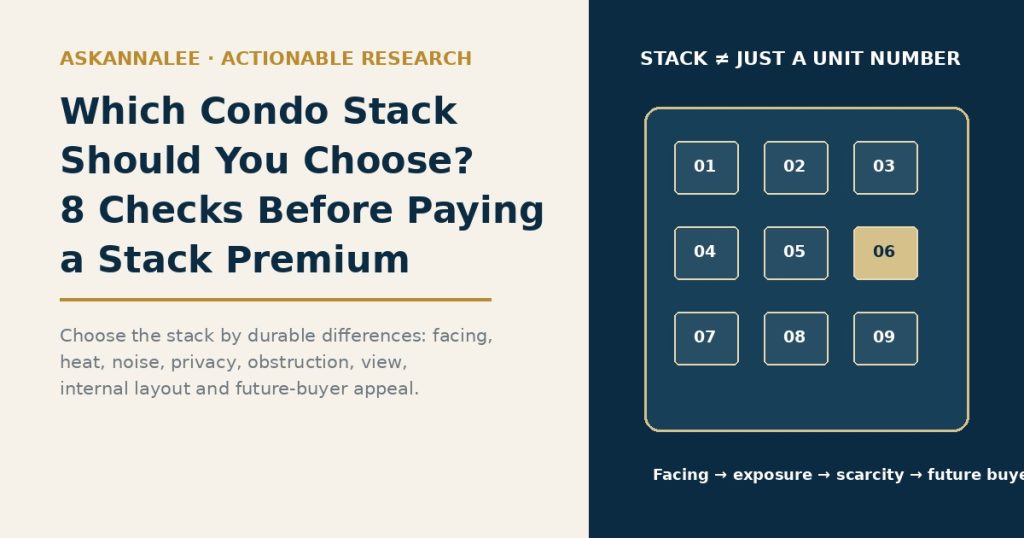
Two stacks in the same development can have very different heat, noise, privacy, view and resale characteristics—even when the floor plan looks identical.
Quick Answer
The best condo stack is not automatically the highest-priced, most open-looking or most popular stack at launch. Compare facing, solar exposure, noise, privacy, view durability, internal layout, dollar premium and future-buyer appeal. The winning stack is the one whose advantages remain useful and scarce after the launch-day story has faded.
Why Stack Selection Matters More Than the Unit Number
Within the same condominium, stacks can share the same floor plan yet deliver very different experiences. One may face a quieter internal garden while another faces a road; one may receive stronger afternoon sun; one may look directly into another block; another may have a more open outlook.
That makes stack selection a relative-value decision inside the project. The question is not whether a stack is “good” in isolation. It is whether its advantages are material enough to justify its price relative to the best realistic alternative.
The facing, privacy, noise conditions or outlook are clearly better; the advantage is difficult to replicate; and future surrounding development is unlikely to erase it.
The stack costs more but the lived experience changes little, the view is vulnerable, or buyers can choose a cheaper stack without giving up much.
Start With the Site Plan, Not the Price List
Before comparing prices, mark every stack on the site plan. Identify roads, entrances, drop-off points, pools, playgrounds, clubhouses, courts, carpark ramps, bin centres, substations, neighbouring blocks and surrounding land.
Then ask what each stack actually sees and hears. A project brochure may describe the overall development beautifully, but resale buyers purchase a specific unit with a specific orientation and exposure.
Check Sun and Heat as an Exposure Problem
Do not reduce orientation to a simplistic “west is bad” rule. Actual heat depends on façade orientation, glazing, shading, balcony depth and surrounding buildings. BCA’s Green Mark framework explicitly recognises west-facing façade exposure, west-facing windows and sun-shading as relevant thermal-performance considerations.
Practical test: identify the stack’s orientation, inspect the unit or site at the relevant time of day where possible, and compare the exposure with a substitute stack rather than making the decision from compass direction alone.
Noise Must Be Tested at the Source
Noise is stack-specific. A pool-facing unit may be pleasant most of the day but active on weekends; a road-facing stack may change materially by traffic direction and setback; a low-floor unit near a drop-off or carpark ramp can experience something a higher-floor brochure view does not reveal.
Visit more than once where practical. Listen during peak traffic, evenings and weekends. Also distinguish constant background noise from intermittent noise, because buyers react differently to each.
Privacy Is Geometry, Not Marketing
Measure what faces the living room, balcony and bedrooms. Direct block-to-block sightlines can matter even on high floors. Corner positioning can improve privacy, but it can also introduce additional external walls or different exposure.
Use the site plan and actual orientation together. If another block is directly opposite, estimate the separation and angle rather than assuming landscaping or height will solve the issue.
A View Premium Is Only as Strong as the Land in Front of It
URA’s Master Plan is Singapore’s statutory land-use plan and guides development over the next 10 to 15 years. Use URA SPACE and the Master Plan to understand permissible land use and surrounding planning context before paying for an open outlook.
The plan is evidence, not a guarantee of a permanent view. The Master Plan Written Statement itself makes clear that planning provisions do not confer an entitlement to develop land to maximum intensity. Treat view durability as a risk assessment, not a promise.
Measure the Stack Premium in Dollars
Then calculate the actual dollar premium. This is the amount the preferred stack must justify through durable advantages.
| Item | Substitute stack | Preferred stack |
|---|---|---|
| Purchase price | S$1,850,000 | S$1,930,000 |
| Dollar premium | — | S$80,000 |
| Premium % | — | 4.3% |
Decision question: what exactly does the extra S$80,000 buy, and will the future buyer still pay for it?
Use Same-Project Transactions to Test Whether Buyers Pay for the Difference
URA’s private residential transaction service provides transaction records from the last 60 months, while REALIS provides more detailed property-market statistics. Use those records to compare similar unit sizes and floor bands inside the same development where possible.
Transaction data will not always identify every qualitative stack difference, so use it as market evidence alongside the site plan and physical inspection—not as a substitute for them.
Worked Example: The More Expensive Stack Is Not Automatically the Better Buy
Assume two similar units on comparable floors:
| Factor | Stack A | Stack B |
|---|---|---|
| Price | S$1.85m | S$1.93m |
| Facing | Internal garden | Open outward view |
| Afternoon exposure | Lower | Higher |
| Noise | Possible facility activity | Road exposure |
| Privacy | Some block-facing risk | More open |
| Future obstruction | Low internal risk | Requires surrounding-land check |
| Premium | — | S$80,000 / 4.3% |
Stack B may still be the better home, but its S$80,000 premium is not justified by the word “open” alone. The buyer should verify the view, road exposure and surrounding planning context, then decide how much of the premium remains defensible.
It materially improves privacy, noise conditions, outlook or liveability; the difference is scarce; planning risk is acceptable; and the total quantum remains competitive.
The experience is broadly similar, the expensive stack’s view is fragile, or the extra dollars would be better preserved as margin of safety for resale.
Research Worksheet: Compare the Stacks Before You Choose
Complete this for the preferred stack and at least one realistic substitute.
| Research item | Your evidence |
|---|---|
| Preferred stack / substitute stack | ________________ |
| Facing / orientation | ________________ |
| Sun / heat exposure | ________________ |
| Noise sources | ________________ |
| Privacy / block separation | ________________ |
| View / obstruction risk | ________________ |
| Internal-layout differences | ________________ |
| Dollar premium / premium % | ________________ |
| Same-project resale evidence | ________________ |
| Maximum defensible premium | ________________ |
8 Checks Before You Pay a Stack Premium
Use all eight checks together. A stack does not become a good buy merely because it wins on one feature.
Facing Test
What does the stack actually face today—road, pool, facilities, neighbouring blocks, greenery, landed homes or open land—and how much of that experience is visible from the unit?
Heat & Orientation Test
Does the stack receive strong afternoon sun or other solar exposure, and how do glazing, shading and surrounding buildings affect the actual lived experience?
Noise Test
Check roads, drop-off points, pools, playgrounds, courts, bin centres, carpark ramps, MRT/rail infrastructure and commercial activity at the times you are likely to use the home.
Privacy Test
Measure direct window-to-window and balcony-to-balcony exposure. A higher floor does not solve privacy if another block directly faces the stack.
View & Obstruction Test
Is the outlook materially better than competing stacks, and could surrounding land or future development remove the advantage you are paying for?
Internal-Layout Test
Does this stack introduce awkward walls, unusable balcony depth, AC ledges, service-yard exposure, structural columns or bedroom geometry that affects liveability?
Dollar-Premium Test
Convert the stack premium into actual dollars. Ask what specific, durable benefits justify paying that amount over the best realistic substitute in the same project.
Future-Buyer Test
Will the next buyer immediately understand the advantage, and will the resulting total quantum remain competitive against other stacks and nearby projects?
How to Interpret the Stack Test
The strongest stack is not necessarily the one with the highest score or highest asking price. Look for durable advantages, proportionate premium and future-buyer clarity.
Stack premium looks defensible
The stack combines materially better facing, privacy, noise conditions or view; the benefits are durable and scarce; and the dollar premium remains proportionate to the future-buyer advantage.
Choose the stack, negotiate the premium
The stack is clearly preferable, but the asking gap is larger than the evidence supports. The right unit may still be the right choice at a lower entry premium.
Choose the cheaper substitute
The premium is driven mainly by marketing, a fragile view or minor differences. A cheaper stack offers almost the same lived experience and leaves a wider resale buyer pool.
Compare the Best Substitute Before You Commit
Rank the stacks by lived experience first. Only then compare the dollar premium and decide whether the preferred stack is worth paying for.
FLOOR PREMIUMRead the High-Floor Premium Guide →
COMPARE VALUERead PSF vs Quantum →
Apply this to a real new launch
Use the stack framework while reading project analysis and comparing actual price ladders.
Work backwards from resale
Test whether the higher purchase quantum still leaves a realistic exit for the next buyer.
Sources & Verification
Primary sources used for this guide:
- URA — Private Residential Property Transactions
- URA — Private Residential Properties / Property Data
- URA — Master Plan 2025
- URA — Master Plan Written Statement 2025
- BCA — Green Mark Certification Standard
URA planning and transaction sources establish the official planning and market-data context. BCA material supports the thermal-exposure discussion. Worked examples are illustrative and must be replaced with project-specific evidence before making a purchase decision.
Educational disclaimer: This guide is for general education and property research only. It is not financial, tax, legal or investment advice. Verify current transaction data, planning information, site conditions and project-specific facts before making a property decision.