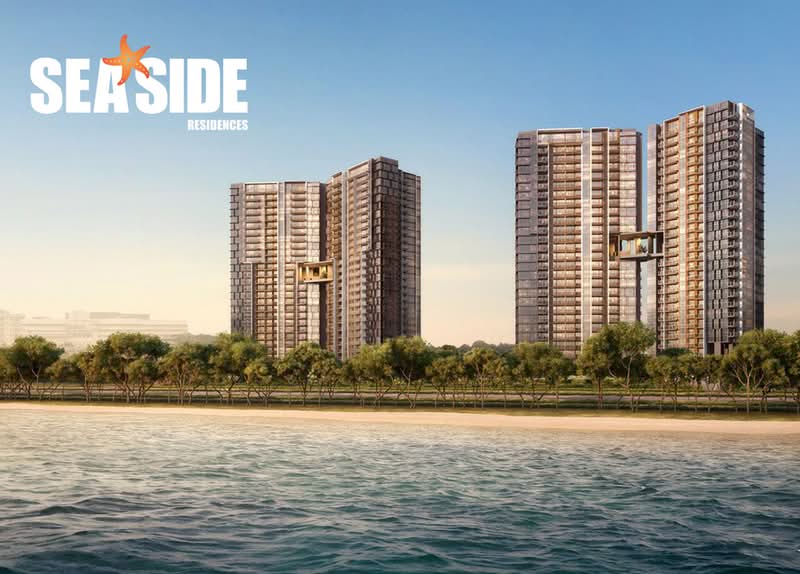
Seaside Residences Backtest: The Buy That Barely Qualified — Then Barely Moved
Seaside Residences gives us a harder case: an exact purchase that technically cleared the frozen price ceiling, yet produced almost no capital appreciation at its first observed exit.
This is a retrospective application of the frozen AskAnnaLee methodology to historical transactions. It does not represent a recommendation AskAnnaLee actually published in 2017. The first observed exit occurred after about 2.5 years, outside the framework's locked 3–5 year core validation window, so this case is not counted as a formal core FAIL.
A genuine qualifying entry produced a weak first outcome — but too early to count as a formal 3–5 year failure.
An exact 1,087 sq ft unit entered at S$1,570,940, only about S$5,360 below the frozen maximum of approximately S$1,576,300.
It subsequently sold for S$1.58 million after roughly 2.5 years, producing only +0.58% appreciation.
CORE INCONCLUSIVE
1. Why Seaside Residences Is Important
This is the first exact observation in the audit where the frozen valuation rule technically said BUY, yet the first observed resale outcome was below the framework's 5% value-preservation threshold.
A model should be judged not only by the winners it captures, but by how it behaves at the edge of its own threshold.
2. What Was Knowable at Launch
Historical reconstruction placed the Seaside Residences land cost at approximately S$858 psf ppr, with estimated breakeven around S$1,400 psf. Launch-era evidence later showed average pricing around S$1,721 psf.
The 99-year lease commenced on 18 April 2016, with TOP in 2021.
3. The Frozen Maximum Entry Price
The frozen audit reconstructed Seaside's intrinsic-value PSF at approximately S$1,595.15.
AskAnnaLee Historical Maximum Entry Price: ~S$1,450.14 psf
For the exact 1,087 sq ft unit, the corresponding maximum quantum was approximately S$1,576,300.
4. The Exact Unit That Qualified
The unit purchased on 22 April 2017 transacted at S$1,570,940.
| Price Test | Amount | Decision |
|---|---|---|
| Frozen Maximum | ~S$1,576,300 | Hard ceiling |
| Actual Entry | S$1,570,940 | PASS |
| Headroom | ~S$5,360 | ~0.34% below maximum |
5. The First Observed Exit
The same exact unit sold on 6 November 2019 for S$1.58 million.
The historical validation protocol locks the primary outcome window at 3–5 years. Because this sale happened before year three, it is treated as a robustness warning rather than included in the core success/failure scorecard.
6. The Broader Framework Would Have Been More Cautious
The later four-gate audit did not treat this marginal price pass as an automatic BUY. Market support was assessed with caution and downside robustness failed. The broader conclusion was therefore WATCH / NEGOTIATE, not BUY — VALUE PROTECTED.
7. The Threshold Cliff
An exact 807 sq ft unit purchased in May 2017 at S$1.190 million sat only about 1.7% above its frozen maximum of roughly S$1.170 million. Because it exceeded the ceiling, the rule said DONT BUY.
The same unit later sold for S$1.450 million after about 4.1 years — a gain of roughly +21.8%.
One purchase slightly below the threshold produced only +0.58% at its first exit. Another purchase slightly above the threshold later produced +21.8% inside the core window. Hard thresholds improve discipline, but they do not eliminate uncertainty.
8. Other Exact Seaside Outcomes
| Exact Observation | Hold | Return | Historical Classification |
|---|---|---|---|
| 807 sq ft | 4.1Y | +21.8% | Opportunity-Cost Rejection |
| 420 sq ft | 3.7Y | +21.2% | Opportunity-Cost Rejection |
| 786 sq ft | 3.5Y | +11.5% | Opportunity-Cost Rejection |
| 1,206 sq ft | 3.5Y | +15.2% | Opportunity-Cost Rejection |
A separate 786 sq ft exact unit produced only about +8.4% over 3.3 years and was correctly rejected by the price gate.
9. The Correct Result
ROBUSTNESS WARNING — CORE INCONCLUSIVE
The exact qualifying unit produced only +0.58%, which is below the model's success threshold. But because its first exit occurred after only 2.5 years, it cannot be counted as a formal 3–5 year false positive.
It remains the strongest known warning that a marginal Gate 1 pass is not sufficient by itself.
THE THRESHOLD
10. What We Learned
The qualifying unit had only about 0.34% headroom and barely moved at its first exit.
A 2.5-year outcome cannot be mixed into a 3–5 year scorecard simply because it makes the model look worse or better.
A unit only 1.7% above the ceiling later gained 21.8%, while the unit just below it barely appreciated at the first exit.
Broader market-support, exit-demand and downside checks can add useful caution around marginal valuation passes.
The correct response is to publish the evidence, retain the rule, and continue testing.
11. Methodology Note
The Seaside audit uses exact same-unit transaction chains. The core validation window is fixed at 3–5 years. Exact outcomes outside that window are retained as robustness evidence but excluded from the formal core performance scorecard.
This analysis is retrospective. It applies a frozen investment framework to historical evidence and does not represent a contemporaneous recommendation. The +0.58% observation is an important robustness counterexample but is outside the locked core validation window.
99.co — Seaside Residences launch-era review
Stacked Homes — Seaside Residences review
PropertyNoob — Seaside Residences sales
PropertyNoob — Seaside Residences profitability
This is the kind of uncomfortable case the track record needs.
Seaside does not give us a neat victory. It exposes both a weak qualifying observation and profitable rejected units. That makes it more valuable for validating the framework than another uncomplicated winner.