Developer Land Cost & PSF PPR Explained
Land cost is one of the largest inputs in a new condo, but it is not the same thing as fair value. Learn what PSF PPR measures, how to read a developer’s land bid, and why buyers should still compare the launch price with real alternatives and future exit value.
Developer cost can help explain a launch price. It does not prove that the launch price is worth paying.
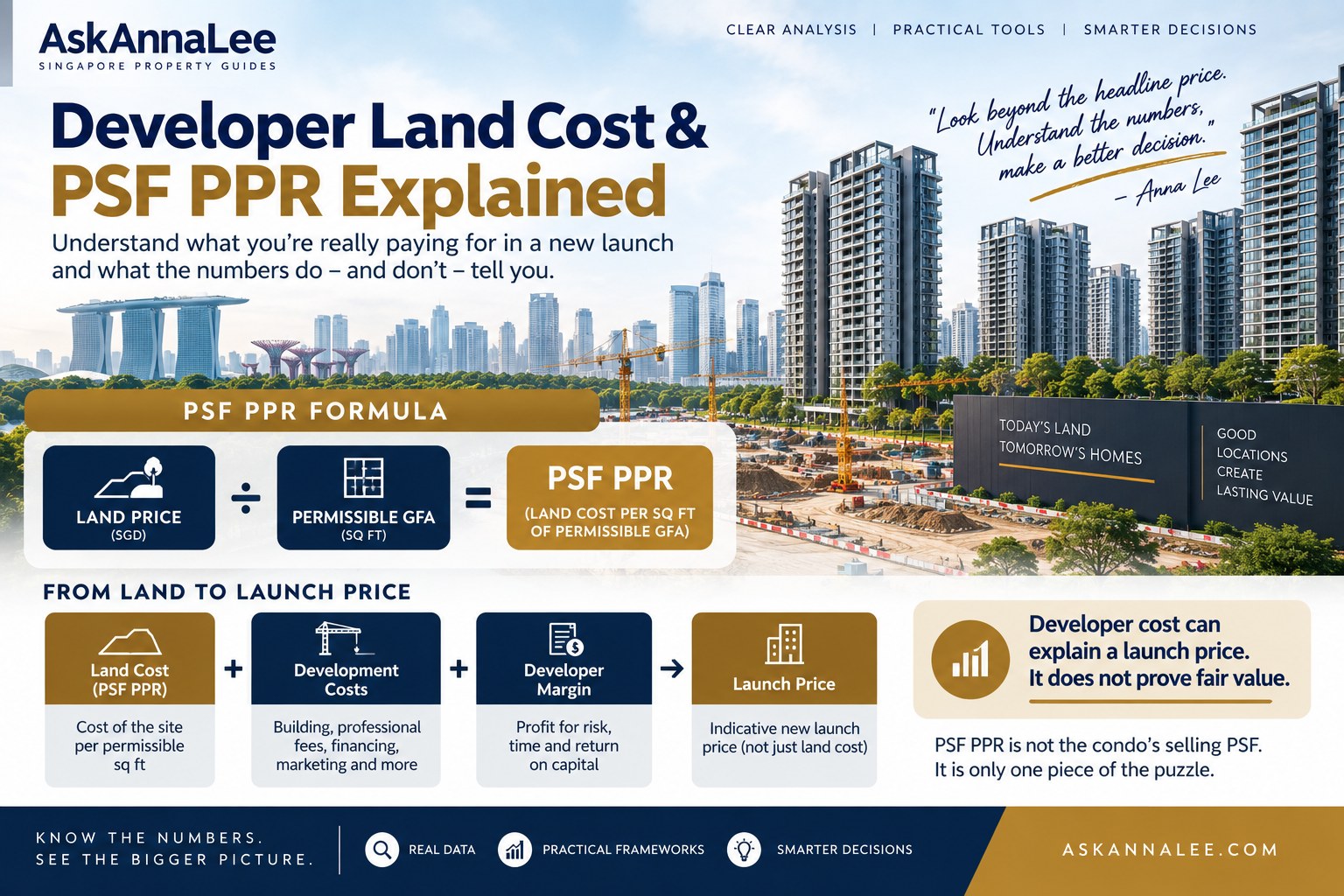
Land cost helps explain how a developer arrives at a launch price. Your buying decision still depends on whether that price is supported by value, alternatives and a realistic future exit.
Quick Answer
PSF PPR means land price per square foot of permissible gross floor area. A simplified calculation is land tender price ÷ maximum permissible GFA, converted to square feet.
It helps compare land bids and understand the developer’s starting cost base. Construction, professional fees, financing, marketing, taxes, contingencies and required return also matter — but none automatically determines what a buyer should pay.

PSF PPR explains the land-cost starting point. The buyer still has to test whether the eventual launch price is supported by market evidence.
Land Cost Explains the Developer — Not the Buyer
New-launch discussions often start with the developer’s land bid and add assumed construction cost and margin. That can explain project economics, but it becomes dangerous when developer cost is treated as buyer value.
Your investment result depends on entry price, competing homes, future buyer affordability and eventual exit — not on whether the developer paid a high price for land.
Use PSF PPR as a cost-context tool, then return to buyer evidence: comparable transactions, total quantum, future supply, affordability and required exit price.
Step 1: Understand What PSF PPR Measures
URA publishes tendered land prices together with maximum permissible Gross Floor Area for many GLS sites. PSF PPR expresses the land price against that development potential.
Simplified formula: Land price ÷ permissible GFA in square feet = land PSF PPR.
For example, URA’s 4 September 2026 award for New Upper Changi Road reported a tendered price of S$1.425388 billion and maximum permissible GFA of 86,154 sq m. The published rate was S$16,544.65 per sq m of GFA — roughly S$1,537 per sq ft of GFA after unit conversion. This is land cost per permissible floor area, not the future condo selling PSF.

Land cost is only the first layer. Construction, financing, professional fees, marketing, risk and margin sit between the land bid and the eventual launch price.
Step 2: Do Not Treat Land Cost as the Full Development Cost
A developer still has to build and sell the project. Construction, consultants, financing, marketing, statutory charges, contingencies and other project costs sit above the land bid. The developer also needs a return for taking development and sales risk.
There is no universal formula saying a certain PSF PPR must produce a certain launch PSF. Project design, efficiency, market conditions, unit mix, timing and commercial strategy can materially change the outcome.
Step 3: Bring the Analysis Back to Fair Value
Once land-cost context is understood, compare the launch with actual transactions in relevant new and resale projects. URA’s transaction database provides private residential transaction evidence.
Then test total quantum and work backwards from a realistic future exit. A project can have an understandable launch price from the developer’s perspective and still be unattractive at that price from the buyer’s perspective.

Developer cost explains how a project reaches the market. Buyer value still depends on comparable prices, total quantum and a realistic future exit.
8 Checks Before Land Cost Becomes Buyer Value
Use these checks together. PSF PPR explains the developer’s starting point; buyer value still has to be supported by the market and a realistic exit.
Was the land acquired through GLS, collective sale or another route, and what does that imply for the starting cost?
What is the land price per square foot of permissible gross floor area?
What construction, financing, professional, marketing and contingency costs sit above the land price?
How far does the asking PSF sit above the developer’s cost context—and is that premium commercially understandable?
Do actual nearby new-launch and resale transactions support the asking price?
Is the total purchase price competitive for the unit type and realistic buyer pool?
What projects and unit types may compete with this property when you eventually sell?
Can a future buyer realistically support the selling price you would need after costs?
How to Read the Result
Cost Context Supports the Price
Land and development cost context helps explain the launch price, while comparable transactions, total quantum and a realistic future exit also support what the buyer is being asked to pay.
Cost Is Explainable, Value Needs Testing
The developer’s cost base may explain the asking price, but comparable transactions, total quantum or future buyer support still need to justify that price from the buyer’s perspective.
Launch Premium Looks Stretched
The premium above cost appears difficult to support when tested against nearby new-launch and resale alternatives, total quantum or future competition.
Buyer Price Is Difficult to Defend
Even if the developer’s costs are understandable, the buyer price is not sufficiently supported by market evidence or by a realistic selling price at exit.
Understand the Cost — Then Test the Buyer Price
Use developer cost as context, then test the asking price against fair value and the exit price you may eventually need.
01 · FAIR VALUETest Fair Value & Entry Price →02 · PSF VS QUANTUMCompare PSF & Total Quantum →
Related AskAnnaLee Guides
PSF vs Quantum: Which Matters More for Condo Buyers?
Understand why total purchase price can matter just as much as headline PSF when testing affordability and future buyer demand.
Is This Singapore Condo Overpriced? 8 Ways to Check
Once you know your budget, test whether the asking price itself is supported by evidence.
Current Project Analysis
Apply the AskAnnaLee framework to current Singapore new launches.
Sources & Verification
Use official URA land-sale and private residential transaction evidence to establish the developer’s land-cost context and then test whether the eventual buyer price is supported by the market.
URA — Government Land Sales programme →
URA — Past sales sites →
URA — Private residential transaction search →
Method note: PSF PPR is a land-cost comparison metric. Developer cost can explain a launch price, but it does not by itself establish fair buyer value.
Educational disclaimer: This guide is for general educational and research purposes. It is not legal, tax, financial, lending or investment advice. Actual loan eligibility, CPF usage, duties and property suitability depend on your circumstances and prevailing rules.