Is a Condo Near an MRT Always a Better Investment?
A condo near an MRT can be easier to reach, rent and resell, but the station is only one part of the investment. The key question is whether the convenience is valuable enough to justify the extra price you are paying compared with realistic alternatives.
MRT proximity is most valuable when it materially shortens everyday journeys, serves useful destinations and remains difficult for competing projects to replicate. If a buyer pays a large premium simply for the words “near MRT”, much of the future benefit may already be priced in.
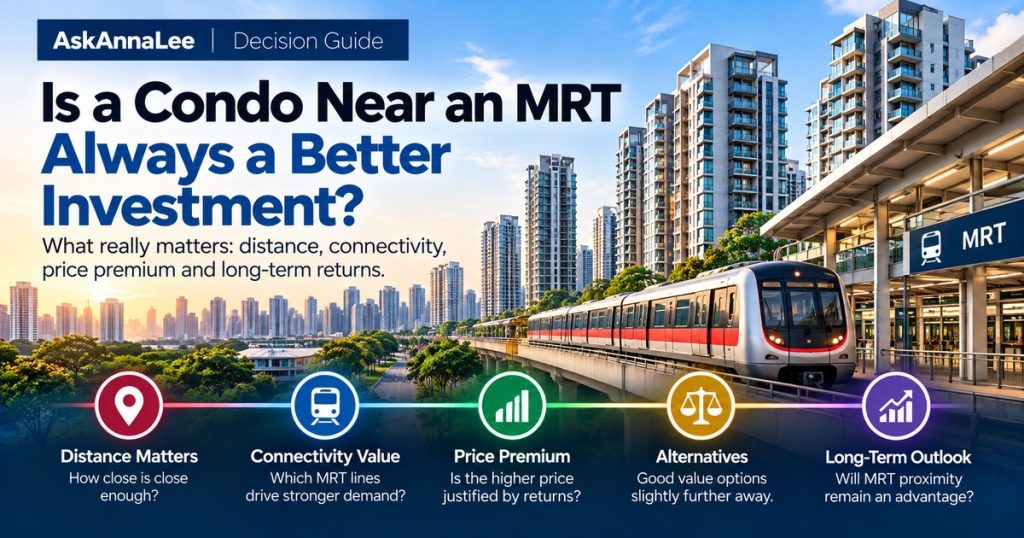
Judge the feature together with price, alternatives and the eventual exit.
Quick Answer
MRT proximity is most valuable when it materially shortens everyday journeys, serves useful destinations and remains difficult for competing projects to replicate. If a buyer pays a large premium simply for the words “near MRT”, much of the future benefit may already be priced in.
Start With Walking Time, Not the Marketing Label
“Near MRT” has no single investment meaning. A sheltered five-minute walk, a ten-minute walk across major roads and a feeder-bus journey can produce very different daily experiences. Compare the actual door-to-platform journey and ask whether the convenience is large enough for tenants and future buyers to notice.
Not Every Station Creates the Same Connectivity
A station is more useful when its line and interchange connections match where households actually travel. Direct access to employment centres, schools and major interchanges can matter more than being physically close to a station with a less useful route. Future rail plans can improve connectivity, but do not pay today as though every announced improvement is already completed.
Treat one attractive feature or market statistic as enough reason to buy.
Measure the advantage, compare alternatives and work backwards from the resale price a future buyer may need to support.
Measure the MRT Premium Against Nearby Alternatives
Compare similar-age, similar-size condos both near and slightly farther from the station. The relevant number is not whether the MRT condo costs more; it is how much more. A modest premium for materially better convenience may be defensible. A very large premium needs stronger rental, resale or scarcity evidence.
The Exit Test: Will the Next Buyer Pay the Same Premium?
Your eventual buyer will compare your unit with newer projects, other stations and homes slightly farther away. The MRT advantage is durable only if the convenience remains meaningful and the required resale price still fits the future buyer’s budget.
8 Checks Before You Pay More for MRT Proximity
Use all eight checks together. One attractive attribute should not override a weak entry price or a narrow future buyer pool.
Distance Test
Time the real walk from the condo entrance to the station platform, including crossings, slopes and unsheltered sections. A small difference on a map can feel much larger in daily use.
Connectivity Test
Check where the line goes, interchange access and whether common employment and lifestyle destinations require transfers. Useful connectivity matters more than station proximity alone.
Price-Premium Test
Compare the unit’s total price and PSF with similar nearby condos outside the immediate MRT radius. Quantify the dollars paid for proximity rather than assuming the premium is automatically recoverable.
Alternative-Location Test
Look for condos one stop away or a few minutes farther from the station. If buyers can obtain similar convenience for materially less money, your exit premium may be harder to defend.
Rental-Demand Test
Check whether tenants in the specific area actually value rail access and whether near-station rents compensate for the higher purchase price. Higher rent does not help if the purchase premium is much larger.
Future-Rail Test
Review confirmed future stations and lines that may improve competing locations. New connectivity can strengthen your area, but it can also reduce the scarcity of your current MRT advantage.
Resale-Buyer Test
Identify the likely future buyer—single professional, couple, family or upgrader—and ask how much of their budget they would realistically allocate to MRT convenience.
Exit-Price Test
Work backwards from the resale price needed for an acceptable return. Then test whether that future quantum remains plausible versus other condos with equal or better connectivity.
How to Interpret the Test
The result should tell you what must be true for the purchase to remain defensible.
Evidence Is Supportive
The factor appears defensible at the current price and remains useful to a realistic future buyer.
Price Matters More Than the Feature
The underlying attribute has value, but the premium paid may already capture too much of that advantage.
More Evidence Is Needed
The conclusion depends on local transactions, competing projects or buyer affordability that should be verified before purchase.
Margin of Safety Is Thin
The required future price assumes too much appreciation or too narrow a buyer pool. Re-test the entry price or consider alternatives.
Test the Price Before You Commit
Use the relevant AskAnnaLee calculator to work backwards from the numbers, then compare the result with realistic future buyer demand.
CALCULATEOpen the Relevant Calculator →
STRESS-TESTFuture Buyer Test →
Apply the Framework to Real Projects
See how AskAnnaLee tests price, competition, affordability and exit risk on individual Singapore projects.
Compare With Historical Outcomes
Use AskAnnaLee backtests to see how entry price and market context affected completed projects.
Sources & Verification
Primary sources used for this guide:
Market statistics and public-policy inputs were checked against primary Singapore sources current at publication. They are inputs to a decision framework, not forecasts for a specific property.
Educational disclaimer: This guide is for general education and property research only. It is not financial, tax, legal or investment advice. Verify current rules and project-specific facts before making a property decision.