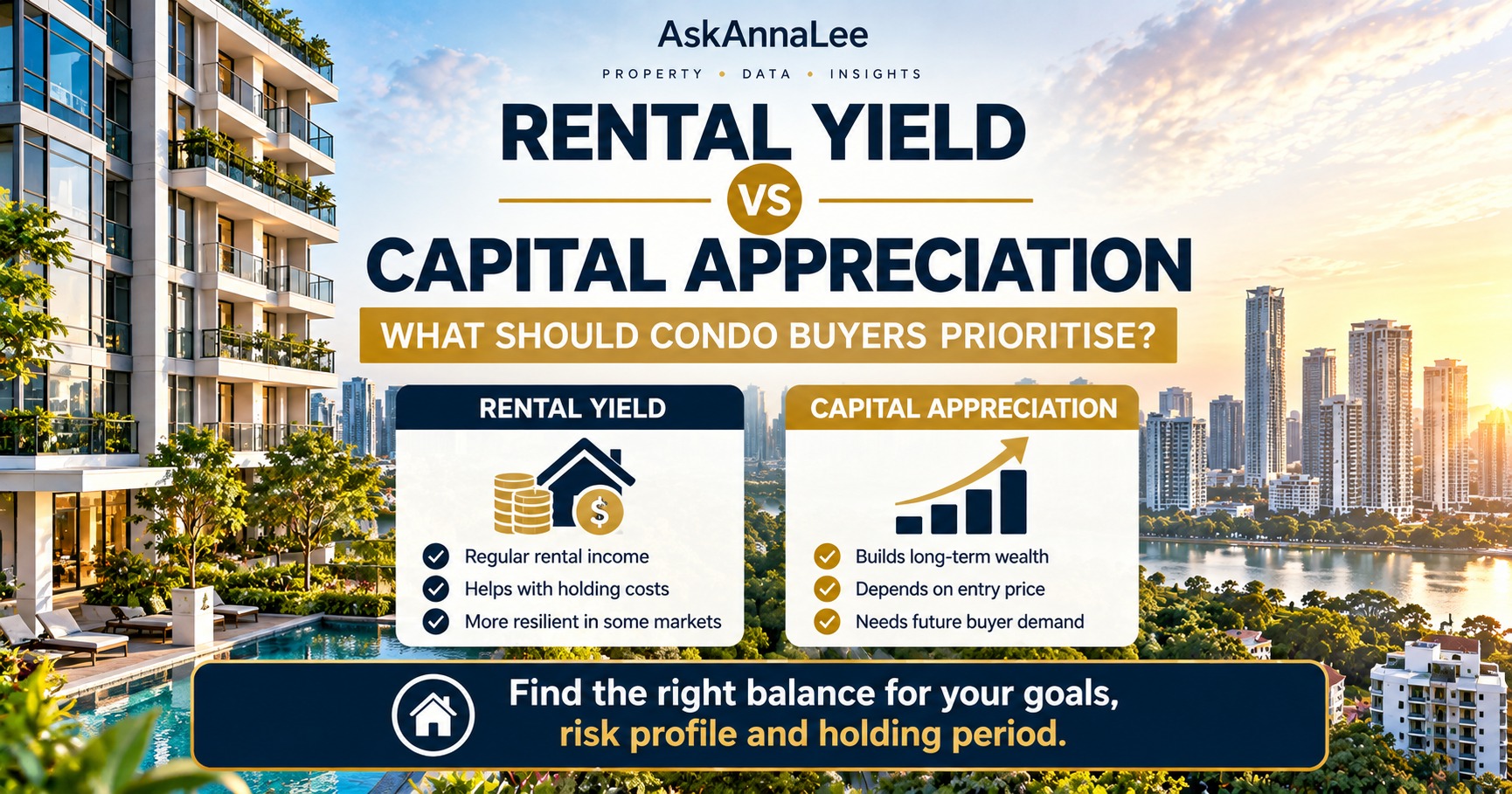
Rental Yield vs Capital Appreciation: What Should Condo Buyers Prioritise?
Rental yield and capital appreciation answer different questions. Yield asks what the property can earn while you hold it. Appreciation asks whether a future buyer may reasonably pay more. A sound purchase should test both against the price you are paying today.
Do not choose yield or appreciation in isolation. Start with your objective, then test the entry price, realistic net rental income, holding costs and the future exit price your purchase requires.
Capital appreciation becomes more defensible when entry price, future buyer affordability and the required exit price still work together.
Quick Answer
A condo has a stronger capital-appreciation case when the entry price is defensible, the future buyer pool remains broad enough, competing supply is manageable and the required future selling price stays realistic.
Are you buying with room for value to grow?
Who can realistically afford the unit later?
What must the next buyer pay for your investment to work?
The AskAnnaLee question: Is the property attractive enough—and the entry price sensible enough—for a future buyer to pay more without the investment depending on perfect market conditions?

Capital appreciation starts with the price you pay. A strong asset bought at an aggressive price can leave little room for the next buyer.
Capital Appreciation Is Not the Same as Buying a “Good Condo”
Location, transport, schools, amenities and developer quality can support demand. But buyers do not receive those benefits for free—they are reflected to some degree in the purchase price.
URA’s 2Q2026 data also shows why Singapore private property should not be treated as one uniform market. Overall private residential prices rose 0.5%, while non-landed prices rose 1.8% in CCR, fell 1.2% in RCR and fell 0.1% in OCR. The particular property, alternatives and entry price still matter.
A good property can still offer limited appreciation if too much future growth is already embedded in the price.
1. Start With the Entry Price
Capital appreciation needs a starting point. Compare the asking price with credible resale and new-launch alternatives, then ask what genuine advantages justify any premium.
The objective is not to find the cheapest condo. It is to avoid paying today for growth that you are expecting to receive tomorrow.
Read: How Much New Launch Premium Is Too Much in Singapore? →

The next buyer compares your unit with alternatives available at that time. Future appreciation must remain affordable and defensible against those choices.
2. Test the Future Buyer and Total Quantum
Your future buyer pays a total price, not just a PSF. A unit may appreciate on paper but become harder to support if the future quantum moves beyond the natural buyer pool.
Future quantum remains accessible to several realistic buyer groups.
The required selling price depends on fewer households being able and willing to pay.
3. Future Supply Can Change the Upside
Your condo will compete with whatever buyers can choose when you eventually sell—not only with what exists today.
For 2026, the Government’s GLS Confirmed List totals 9,320 private homes. The broader private-housing pipeline including ECs was around 61,000 units. This does not mean every project faces the same competition; it means supply should be tested at the relevant location, price band and buyer segment.

Work backwards from the future selling price. The appreciation case is stronger when the required exit still fits a realistic buyer pool despite competing supply.
8 Checks Before You Decide What Should Drive the Purchase
This is a decision framework, not a numerical score. The aim is to expose what must go right for the investment to appreciate from the price you are paying today.
Investment Objective Test
Decide what the property must do for you. If you need recurring income, rental economics deserve more weight. If the objective is long-term wealth growth, the future resale case matters more. Most buyers still need both to be defensible.
Gross vs Net Yield Test
Headline rental yield can look attractive before costs. Test rent against purchase price, then allow for maintenance, property tax, vacancy, agent fees, repairs and financing where relevant. The usable return is the net return.
Entry Price Test
A strong rent does not automatically make an expensive purchase attractive. Compare the entry price with relevant resale alternatives and ask whether you are paying away years of rental income through an excessive purchase premium.
Rental Demand Test
Check who is likely to rent the unit, what competing units they can choose and whether the layout, location and quantum fit that tenant pool. Sustainable rental demand matters more than one optimistic asking rent.
Holding-Cost Test
Estimate the cash needed while you own the property. Mortgage interest, maintenance, taxes, vacancy and repairs can materially change the economics. Positive-looking gross yield can become thin after real ownership costs.
Future Supply Test
New completions can affect both rents and resale competition. Review the surrounding pipeline and ask whether future tenants and buyers will have many substitutes when your unit enters the market.
Appreciation Case Test
Identify the evidence for a higher future value: defensible entry price, broad buyer pool, constrained competing supply or genuine area improvement. Do not treat general market growth as a guaranteed return for one unit.
Required Exit Test
Work backwards from the future selling price needed to make the investment worthwhile after transaction and holding costs. Then ask whether a realistic future buyer could afford and justify paying that price.
How to Interpret the Capital Appreciation Test
Do not turn the eight checks into a numerical score. Instead, identify how much upside the entry price leaves, who must buy from you later, and how demanding the required exit becomes.
Income and Growth Case Look Balanced
Entry price, buyer pool, supply and required exit appear reasonably aligned.
The Trade-Off Needs More Evidence
The property has strengths, but the price already captures part of the expected upside.
Return Margin Looks Thin
The investment depends on a relatively strong future selling price or favourable market conditions.
The Investment Case Is Difficult to Defend
The entry price, future competition or required exit creates too much dependence on future price growth.
Test the Entry Price—Then Stress-Test the Exit
Start with whether the asking price is defensible. Then calculate the future selling price the investment may require and test whether a realistic future buyer could support it.
Related AskAnnaLee Guides
Continue from entry price to future competition and finally to the buyer who must support your exit.
Current Project Analysis
See how AskAnnaLee applies entry price, competition and exit tests to individual Singapore new launches.
Historical Property Backtests
Use past projects to study how entry price and subsequent market outcomes interacted.
AskAnnaLee Method
We do not assume that a good project is automatically a good investment. The price paid remains part of the decision.
Sources & Verification
Primary Singapore sources used for this guide:
- URA — 2Q2026 Real Estate Statistics: private residential price movements by market segment.
- URA — 2H2026 Government Land Sales Programme: current private-housing supply context.
- URA — Private Residential Property Data: transactions, developer sales and pipeline supply.
- IRAS — Seller’s Stamp Duty: current residential SSD holding-period rules.
Method note: Capital appreciation is not guaranteed. AskAnnaLee does not predict a future price. The framework tests whether the entry price and required exit appear defensible using currently available evidence.
Educational disclaimer: This article is for general education and research only. It is not financial, investment, legal, tax or property advice, and it does not recommend buying or avoiding any specific development. Property prices, financing rules, taxes and market conditions can change. Verify current information and obtain professional advice where appropriate before making a property decision.