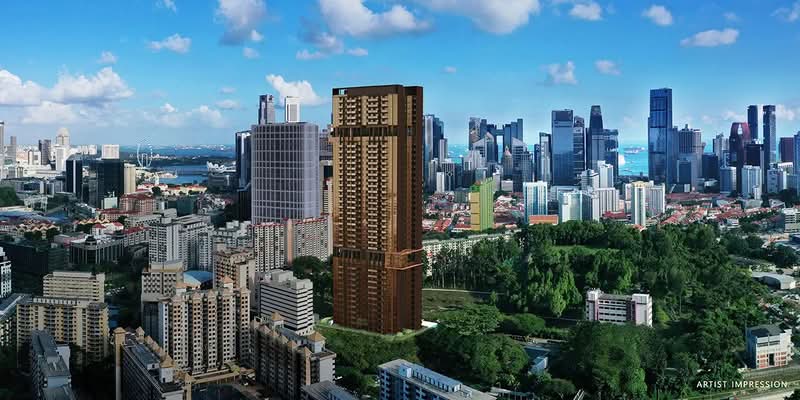
The Landmark Backtest: Where Price Discipline Separated Winners From Losers
The Landmark gives us something more useful than a single success story. Inside the same development, the frozen framework identified qualifying entries that later appreciated — and rejected other exact units that subsequently lost money.
This is a retrospective application of the frozen AskAnnaLee property investment methodology to historical evidence. It does not represent a recommendation AskAnnaLee actually published in 2020 or 2021. Later outcomes are used only to validate the earlier price test and are not permitted to change it.
Two core BUYs both succeeded
Two exact 753 sq ft units qualified below their historical maximum prices and later appreciated approximately +20.8% and +15.3% over about 3.5 years.
Two adverse rejects later lost money
Two exact 495 sq ft entries exceeded their frozen maximum and were rejected. Their later outcomes were approximately −1.8% each.
1. Why The Landmark Is a Better Test
Most property discussions ask whether a development was “good” or “bad”. That is too coarse for investment underwriting.
The Landmark exact-unit audit contained eight matched transaction chains. Four historical entries cleared Gate 1, while other exact units did not. That allows us to test whether the framework distinguished between different prices inside the same project rather than simply benefiting from a rising market.
The useful question is not “Did The Landmark go up?” It is “Did the price paid change the outcome?”
2. What Was Knowable at the Historical Decision Date
Pre-booking research dated 27 November 2020 recorded a land cost of approximately S$1,406 psf ppr, an estimated development breakeven around S$2,000 psf, and nearby One Pearl Bank transaction evidence around S$2,405 psf.
Those inputs were available before the later resale outcomes and therefore could legitimately support the historical intrinsic-value reconstruction.
3. The Frozen Price Ceiling
The frozen V9 audit produced an intrinsic-value PSF of approximately S$2,307.83. After the required valuation protection, the historical Gate 1 ceiling was approximately:
AskAnnaLee Historical Maximum Entry Price: ~S$2,098 psf
For a 753 sq ft unit, that translated to a maximum quantum of approximately S$1.580 million. For a 495 sq ft unit, the corresponding maximum was approximately S$1.039 million.
4. Qualifying Entry #1: S$1.490m
An exact 753 sq ft unit entered on 27 November 2020 at approximately S$1.490 million. Its historical maximum was about S$1.580 million, so Gate 1 passed.
The same unit subsequently sold on 7 June 2024 for approximately S$1.800 million.
The holding period was approximately 3.5 years, inside the core validation window.
5. Qualifying Entry #2: S$1.501m
A second exact 753 sq ft unit entered on 16 January 2021 at approximately S$1.501 million, also below the frozen maximum.
It sold on 18 July 2024 for approximately S$1.730 million.
Again, the holding period was about 3.5 years and the appreciation comfortably exceeded the predefined 5% value-preservation threshold.
6. Now Look at the Rejected Units
The same audit also identified exact units that failed the price test.
| Exact Observation | Historical Entry | Frozen Maximum | Later Outcome | Classification |
|---|---|---|---|---|
| 495 sq ft adverse control | S$1.049m | ~S$1.039m | S$1.030m / −1.8% | CORRECT REJECTION |
| 495 sq ft adverse control | S$1.113m | ~S$1.039m | S$1.093m / −1.8% | CORRECT REJECTION |
The first rejected unit was only slightly above the maximum, yet still recorded a negative subsequent outcome. The second was materially more expensive and also lost value.
7. But the Model Also Missed Some Winners
The audit was not perfect. A near-threshold 678 sq ft unit entered at approximately S$1.429 million against a frozen maximum around S$1.422 million. It was correctly classified as DONT BUY under the frozen rule — but later appreciated.
Another rejected 678 sq ft observation also produced a positive later outcome.
The Landmark audit contains successful BUYs, correct rejections and opportunity-cost rejections. Publishing only the successful observations would exaggerate the framework's precision.
8. The Exact Audit Scorecard
| Audit Measure | Result |
|---|---|
| Exact matched Landmark pairs | 8 |
| Exact Gate 1 BUYs | 4 |
| Core 3–5Y Gate 1 BUYs | 2 |
| Core BUYs ≥5% | 2 / 2 |
| Core BUYs <5% | 0 |
| Adverse exact DONT BUY controls | 2 later losses |
9. What We Learned
Different units inside The Landmark produced different Gate 1 results because their entry prices and quantums differed.
The audit connects original unit identities to later exits rather than assuming same-size transactions are the same property.
The two core qualifying BUYs exceeded the success threshold, while the two adverse rejected 495 sq ft cases lost about 1.8%.
Near-threshold rejected units that later appreciated remain opportunity-cost rejections. They are part of the true performance record.
The frozen maximum remains ~S$2,098 psf even when a rejected unit later performs well.
10. Methodology Note
The Landmark audit uses exact unit-number transaction chains. Exact same-unit evidence outranks project medians, same-size matches and proxies. The frozen framework defines Gate 1 as entry at or below Base IV divided by 1.10; later outcomes cannot change that historical classification.
This analysis is retrospective. It tests a frozen methodology against historical exact-unit evidence and does not represent an investment recommendation actually issued at the time. Historical results do not guarantee similar prospective outcomes.
Pre-booking source used for The Landmark historical reconstruction: land cost ~S$1,406 psf ppr, estimated breakeven ~S$2,000 psf and One Pearl Bank comparable evidence.
Business Times — The Landmark pre-booking evidence
Exact unit transaction histories and profitability cross-checks:
PropertyNoob — The Landmark sales
PropertyNoob — The Landmark profitability
This is what we want the Back Test library to become.
Not a gallery of winners, but a record of exact historical decisions: qualifying entries that worked, qualifying entries that failed, correct rejections and profitable opportunities the framework missed. The Landmark contributes evidence to more than one category.